Eastern's behavior analysis program earns prestigious ABAI accreditation
The only accredited bachelor's program in New England and 1 of 8 worldwide
Willimantic, CT (07/30/2026) — Eastern Connecticut State University's behavior analysis concentration in the psychology major has received accreditation from the Association for Behavior Analysis International (ABAI). Eastern has the only ABAI-accredited bachelor's degree program in New England, and one of only eight worldwide.
Other schools among the eight accredited institutions include universities in West Virginia, Alaska, Florida, Nevada, Bogota, Colombia, and Oslo, Norway. The accreditation is active for the maximum allowable time of seven years.
In its announcement, the ABAI cited the "operational integrity, financial sustainability, and effectiveness" of Eastern's behavior analysis program, and noted that the maximum accreditation period of seven years is "awarded to exemplary programs that consistently exceed the standards." The ABAI evaluation reviews applicant programs' "comprehensiveness, rigor, quality, and transparency."
Eastern's behavior analysis program was the first in Connecticut to be approved by the Behavior Analysis Certification Board. After Jan. 1, 2027, only board-certified behavior analysts will be able to work in the field. Eastern graduates sit for the exam to become board-certified assistant behavior analysts. Many go on to graduate school to earn a master's degree in behavior analysis; graduates are in or have taken advanced degrees at the University of St. Joseph in West Hartford; Columbia University; the University of the Pacific; the University of North Carolina-Wilmington; and Western and Southern Connecticut State Universities, among others.
"This is a great accomplishment," said James Diller, professor of psychology and coordinator of the behavior analysis program at Eastern, in reacting to ABAI's announcement. "I am very proud of our faculty and the program for reaching this level of recognition. It points to the quality of the education we provide; it is nice to be recognized by the profession." Diller also mentions that accreditation serves an important quality assurance and continuous improvement function, "so we can get better and better over time." He also noted, "Coming from an accredited program is beneficial for our graduates" in competing for graduate school acceptance.
Behavior analysis uses a scientific approach to understand how humans and other animals behave. Applied behavior analysis attempts to intervene to improve behavior. Human behavior therapy ranges from reducing aggression to managing food aversion to educational interventions, to helping individuals recover from brain injury. Other careers in the field include behavioral treatment of children with autism and other developmental disabilities; organizational behavior management, including workforce performance and culture; behavioral gerontology; and treatment of substance abuse disorders.
Eastern's program has evolved as the field of behavior analysis has evolved. The first courses in behavior analysis were introduced at Eastern in 2004. Students took a sequence of five courses to prepare to sit for the certification exam to become assistant behavior analysts. In 2011, Diller took over coordinating the program, and in 2014 the 24-credit concentration in the Psychology major was approved by the Board of Regents for Higher Education, the governing body for the Connecticut State Colleges and Universities System. In addition to Diller, faculty assigned to the behavior analysis program include Associate Professor Christopher Krebs and two part-time faculty.
Courses in the concentration include "Ethics and Professional Development for Behavior Analysis"; "Applied Behavior Analysis"; "Radical Behaviorism"; "Behavioral Pharmacology"; and "Behavior Genetics," among others. Gaining research experience is an important goal of the behavior analysis concentration and the five other concentrations within the psychology major. In addition to Applied Behavior Analysis, students take the research course, "Single Subject Design," and all psychology students take 12 credits (three courses) in various aspects of research methods. Each year, students present their research at the on-campus event, "Psychapalooza." Off-campus conferences and academic journals also offer students the opportunity to present their research and publish their findings.
As part of the accreditation process, Eastern has identified and implemented a new experiential learning component of the program. In addition to core courses in the psychology major, along with the 24 credits in the behavior analysis concentration, students must now take a three-credit experiential learning course. They have four options to choose from, including (1) internships at locations such as the Center for Children with Special Needs in Glastonbury, CT; (2) independent study; (3) serving as a teaching assistant; or (4) serving as a research assistant with Diller or Krebs. For example, Krebs worked recently with honors student Gabriel Williams on an independent study that examined impulsivity. Diller partnered with several students to analyze participants in research published in the Journal of Applied Behavior Analysis.
###
Eastern Connecticut State University is the state of Connecticut's public liberal arts university, serving upwards of 4,000 students annually on its Willimantic campus. A residential campus offering 41 majors and 68 minors, Eastern offers students a strong liberal arts foundation grounded in a variety of applied learning opportunities. Ranked among the top 25 public institutions in the North by U.S. News & World Report in its 2025-26 Best Colleges ratings, Eastern has also been awarded 'Green Campus' status by the Princeton Review 15 years in a row. For more information, visit www.easternct.edu.
Media Attachments
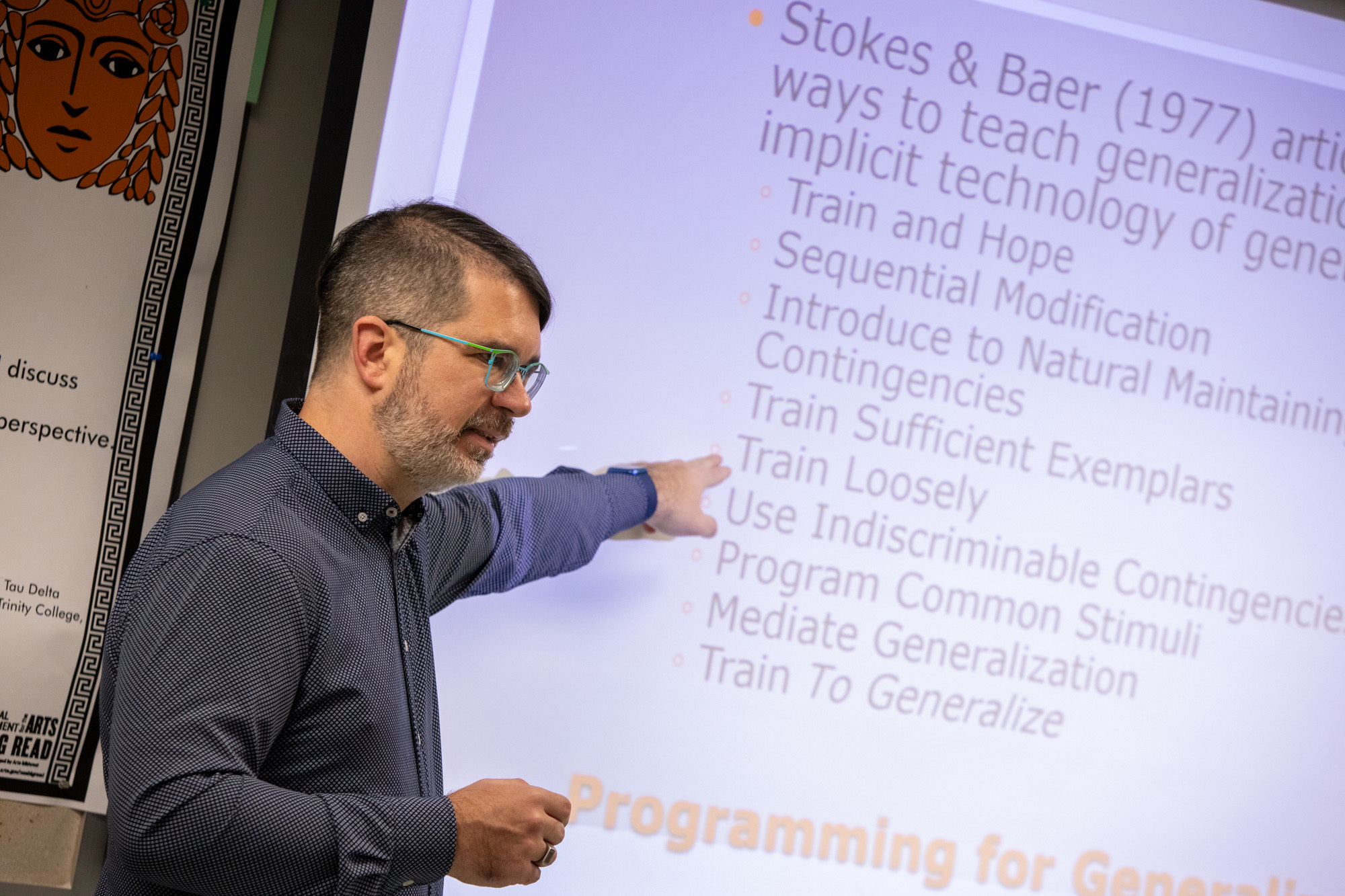
Pyshcology Professor James Diller, coordinator of Eastern's behavior analysis program