Study reveals scorpion venom is not sterile, opening new paths for antibiotic research
Willimantic, CT (01/22/2026) — A new study published today by biologists at Eastern Connecticut State University has revealed that scorpion venom contains complex microbial communities, challenging the long-held scientific belief that venom is sterile and opening new pathways for potential antibiotic discovery.
Published on Jan. 22 in the scientific journal PLOS One by Professors Barbara Murdoch and Matthew Graham, "Microbiota discovered in scorpion venom" is the first assessment of microbial diversity in scorpion venom, according to Murdoch and Graham, who co-authored the article with University of Dubuque biology Professor Adam Kleinschmit and Western Connecticut State University Professor Carlos E. Santibanez-Lopez
"Our study refutes the idea that scorpion venom is a sterile environment lacking bacteria," says Murdoch. "It corroborates the discovery of microorganisms in the venom of other organisms, like spiders and snakes."
According to the study's abstract, the researchers used DNA sequencing to identify microbial communities within the venom and analyzed microbiome diversity between two species: Paruoctonus becki (Beck's Desert scorpion) and Anuroctonus phaiodactylus (California swollen-stinger scorpion), as well as between geographically distant populations and individual scorpions.
The researchers found that not only did the venom contain bacterial communities, but these microbiomes contained a certain degree of diversity between species and individuals.
For example, Murdoch noted that venom samples from populations in Nevada and California contained similar core bacteria, but distinctly different microbiomes.
"What fascinates me most is the realization that every scorpion, of the nearly 3,000 species worldwide, carries a tiny globe of life in its tail," Graham wrote. "[These findings] completely change how we think about scorpion venom. It's not a sterile substance, but a living, dynamic system shaped by ecology, geography, and evolutionary processes."
The discovery raises new questions about other venomous animals. While the discovery of bacteria in scorpion venom doesn't prove their existence in other animals, the researchers note that it prompts a demand to investigate further.
Although the researchers were intrigued by the mere existence of bacteria in the venom, they also recognized possible applications for healthcare and medicine.
"Scorpion stings pose a significant global health concern, as infections often complicate these cases," Murdoch wrote.
Because venom is a harsh environment where few bacteria can survive, she noted that further research into the bacteria that do exist could offer clues to aid the creation of new compounds for antibiotics.
"Understanding the microbial communities in the venom could prevent infection and help inform successful treatment," Murdoch wrote. "We speculate that our study may open an exciting new avenue for bioprospecting the antimicrobial compounds that can be created by venom bacteria and thus the discovery of novel compounds to treat antibiotic infection and antibiotic resistance."
Including "Microbiota Discovered in Scorpion Venom," Murdoch and Graham have published five scholarly works together over the last five years.
"We each bring different skillsets that, when combined, have led to these studies," Murdoch noted. "It's invigorating to have such an amazing colleague to collaborate with."
Murdoch and Graham have been awarded multiple grants to fund their various research initiatives, including awards from the National Science Foundation, NASA, and the American Association of University Professors.
- Read the newly published article on the PLOS One website: https://journals.plos.org/plosone/article?id=10.1371/journal.pone.0328427
###
Eastern Connecticut State University is the state of Connecticut's public liberal arts university, serving upwards of 4,000 students annually on its Willimantic campus. A residential campus offering 41 majors and 68 minors, Eastern offers students a strong liberal arts foundation grounded in a variety of applied learning opportunities. Ranked among the top 25 public institutions in the North by U.S. News & World Report in its 2025-26 Best Colleges ratings, Eastern has also been awarded 'Green Campus' status by the Princeton Review 15 years in a row. For more information, visit www.easternct.edu.
Media Attachments
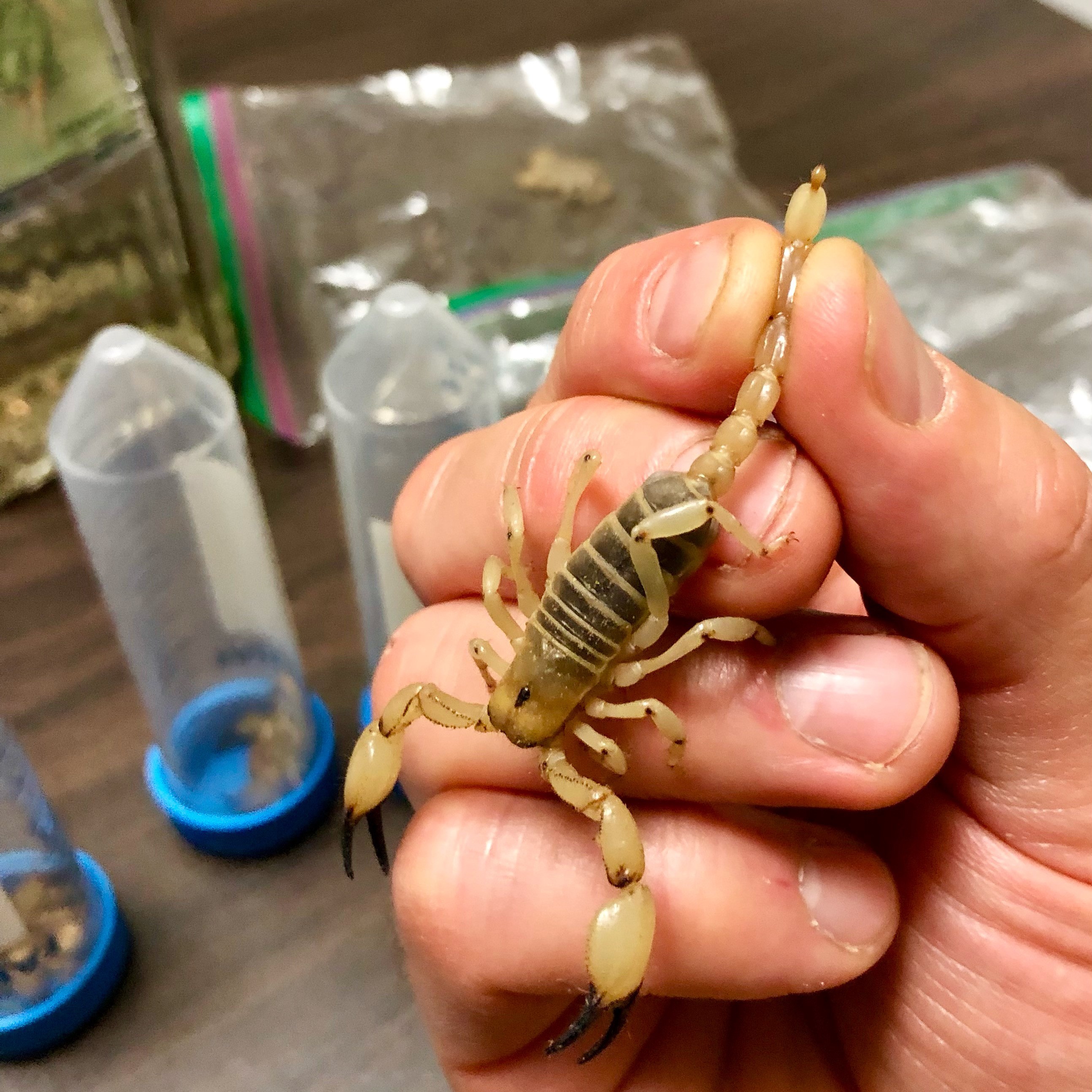
Graham holds a live eastern swollenstinger scorpion by the tail.

Professor Barbara Murdoch

Professor Matthew Graham

A field site near Tonopah, AZ

Eastern Connecticut State University
Michael Rouleau, (860) 465-0172, rouleaum@easternct.edu; universityrelations@easternct.eduShare this Story


Recent News
- Media Advisory: Political historian available to press this election season
- Cindy Blackman Santana Trio to perform benefit concert at Eastern on Oct. 23
- Academy of Arts & Sciences inductee Marc Freeman '93 to return to Eastern
- The Last Green Valley establishes headquarters at Eastern's historic Church Farm
- Eastern to host Banned Books Week event Oct. 6
- Eastern ranked 15th in nation among public liberal arts colleges
- Eastern geologist receives $270,000 to study climate-driven coastal erosion
- Eastern hosting free small-business academy this fall
- Eastern early childhood experts weigh in on Dolly Parton's literacy legacy
- Eastern announces 2026-27 mainstage theatre season